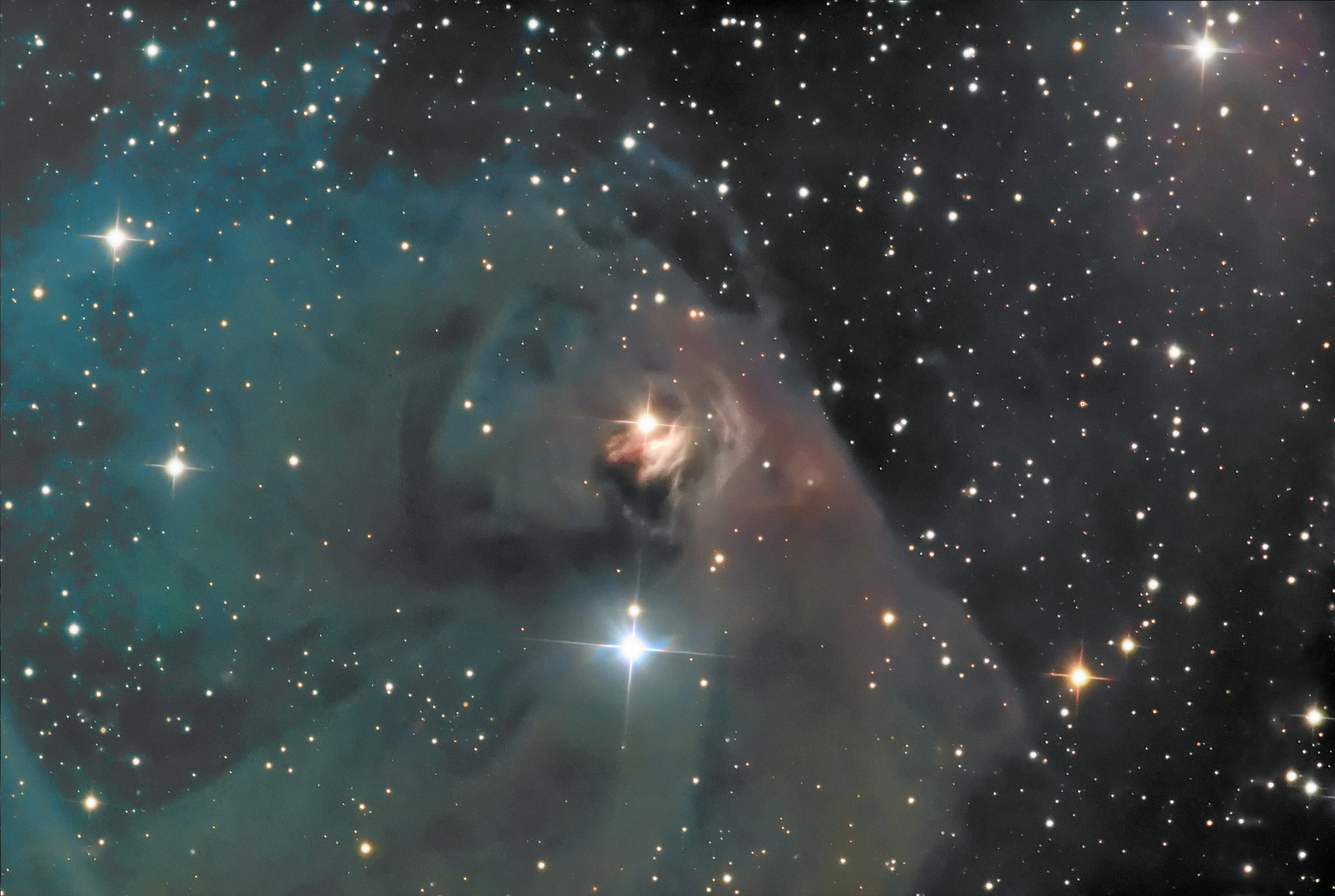
 The bright star in the center of the photo is T Tauri. T Tauri is the prototype for the type of stars named after it. These are stars that have recently been revealed from the gasous clouds in which they were formed. They are usually a few million years old, and still in the early stages of development. The large cloud next to T Tauri is known as Hind's Variable Nebula. Hind's Nebula is interesting because it can vary drastically in brightness. The scope of the photo is about 4 lightyears across.
Friday, December 14, 2007
2.7 APOD
The bright star in the center of the photo is T Tauri. T Tauri is the prototype for the type of stars named after it. These are stars that have recently been revealed from the gasous clouds in which they were formed. They are usually a few million years old, and still in the early stages of development. The large cloud next to T Tauri is known as Hind's Variable Nebula. Hind's Nebula is interesting because it can vary drastically in brightness. The scope of the photo is about 4 lightyears across.
Friday, December 7, 2007
2.6 APOD
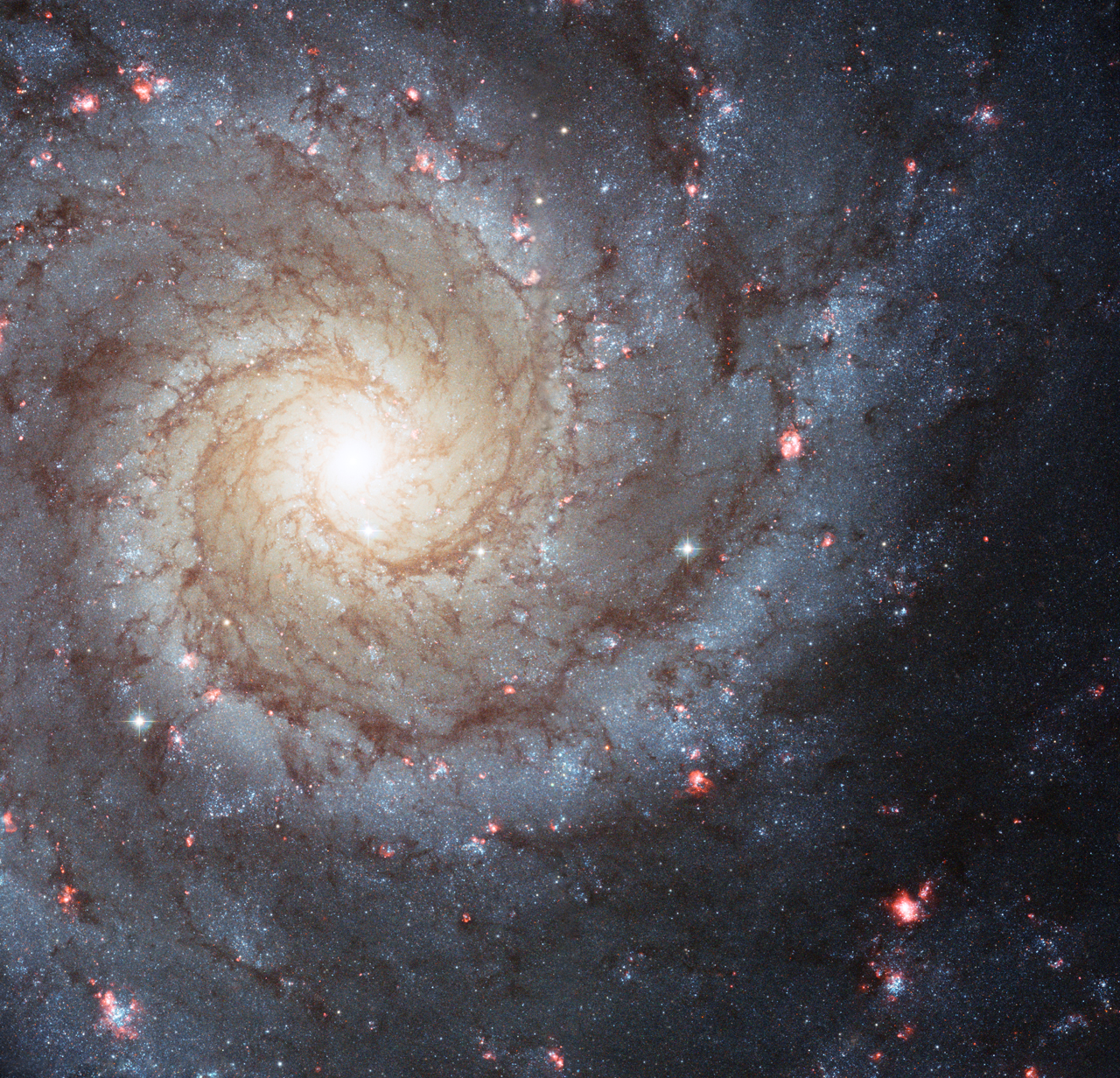 This is a spiral galaxy known as M47. It is composed of about 100 billion stars and is located 32 million light-years away from Earth, near the constellation Pisces. The arms of the spiral are made up of dust and gas, as well as blue star clusters. The red sections in the galaxy are star forming regions. The color comes from hydrogen gas. M47 is about 30,000 light-years across, and this photo was constructed from shots taken by the Hubble Space Telescope between 2003 and 2005.
Friday, November 30, 2007
2.5 APOD
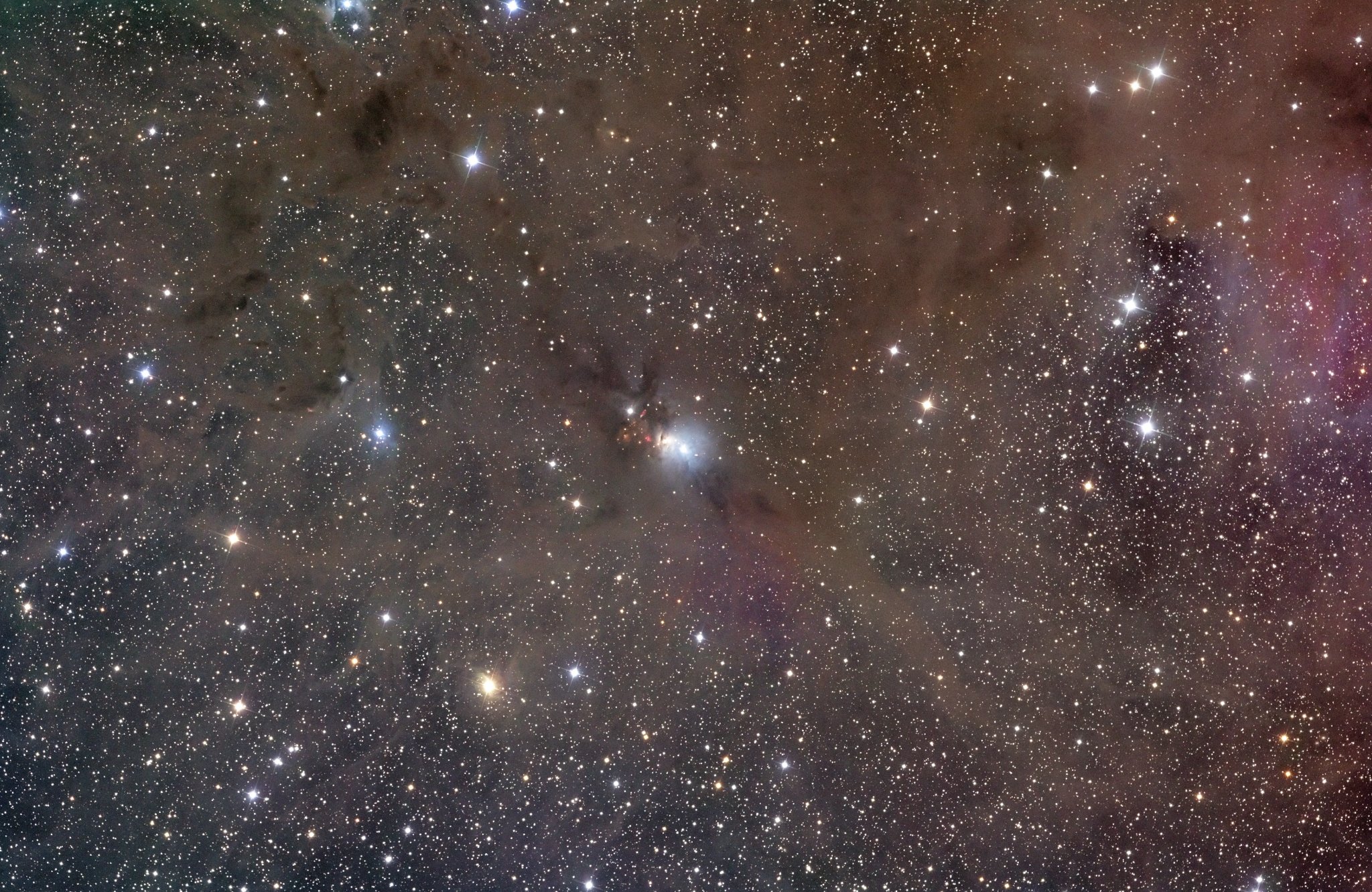 Here in Perseus is a minxture of dust, gas and stars that spans about 4 degrees of the sky. The large bright spot in the center is the object NGC 1333 which is a reflection nebula that has been mapped by radio waves. It is one of the closest star forming regions to Earth, at about
1,000 light-years away. The red glow in the picture comes from hydrogen gas, and the region is part of a larger molecular cloud that leads scientists to believe that this is a star forming region. These clouds typically hide young stars. This type of "stellar nursuries" are common.
Friday, November 16, 2007
2.4 APOD
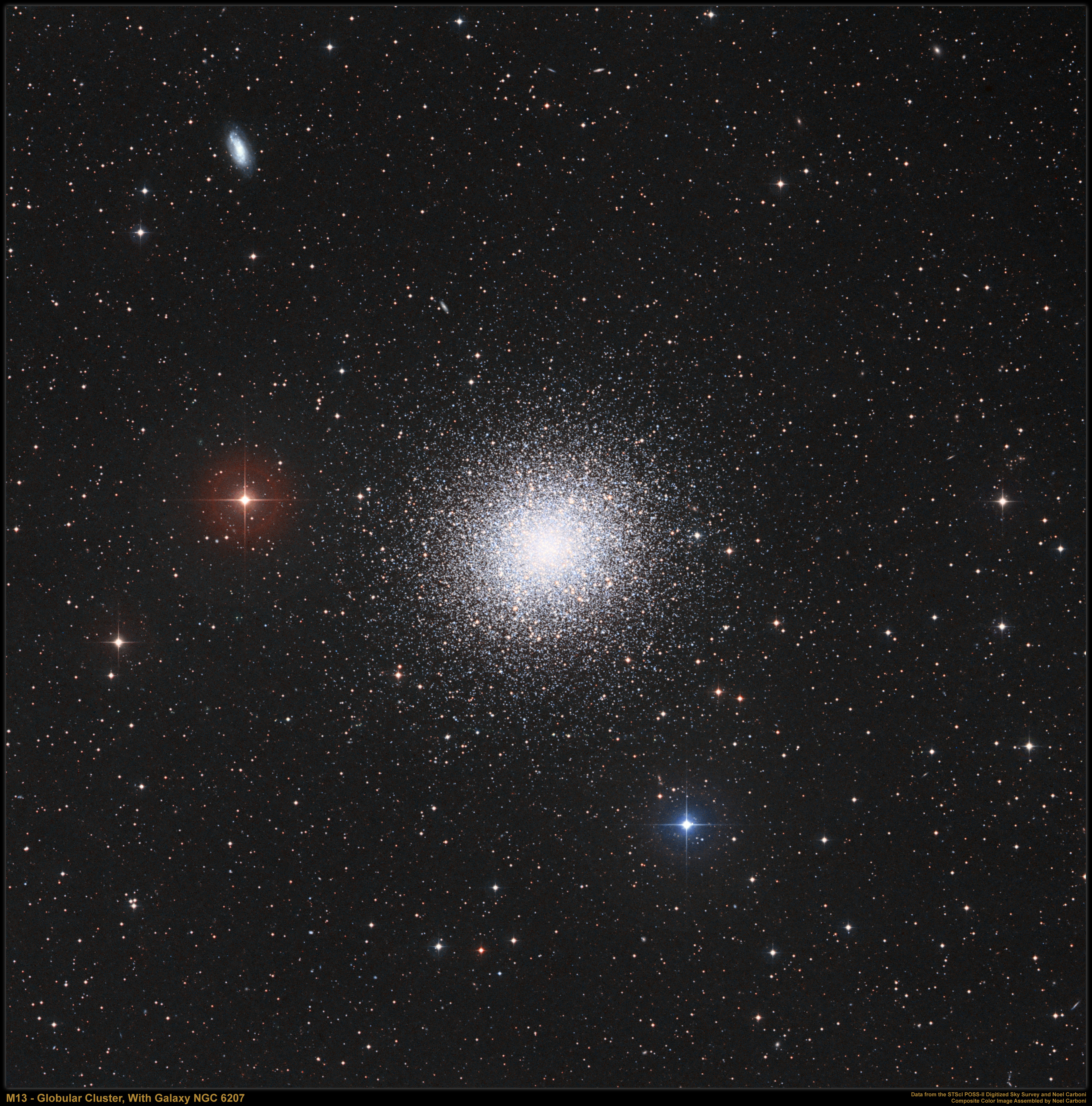 This is a shot of the M13 globular cluster in the constellation Hercules. This cluster is home to hundreds of thousands of stars, making it one of the brightest clusters in the northern sky. The cluster, which is over 25,000 lightyears away, is about 145 lightyears wide. It is widely excpeted that M13 is between 14 and 24 billion years old. Also in the top left of the photo is a galaxy called NGC 6207. M13 was discovered by Sir Edmond Halley in 1714, and is a favorite of amateur astronomers because it so much brighter than most globular clusters.
Monday, November 12, 2007
Observation 2.1
Date: November 5, 2007
Time: 7:00-9:00
Place: Suncoast Community Church (Clark Road east of the Interstate)
Sky conditions: Clear
Instruments used: binoculars, school telescope
Planets: Jupiter (Setting)
Bright Stars: Aldebaran, Altair, Vega, Deneb, Polaris, Fomalhaut
Constellations: Cassiopeia, Cygnus, Cepheus, Taurus, Delphinius, Pisces Austrinus, Lyra, Vulpecula
Binary Stars: Epsilon Lyrea (difficult to distinguish the different colors)
Deep Sky Objects: M45 (Star cluster), M57, M31, M27 (all but M45 mostly looked like fuzzy circles)
Other: Holmes Comet (visible with the naked eye, looked fuzzy, did not yet have a tail)
Time: 7:00-9:00
Place: Suncoast Community Church (Clark Road east of the Interstate)
Sky conditions: Clear
Instruments used: binoculars, school telescope
Planets: Jupiter (Setting)
Bright Stars: Aldebaran, Altair, Vega, Deneb, Polaris, Fomalhaut
Constellations: Cassiopeia, Cygnus, Cepheus, Taurus, Delphinius, Pisces Austrinus, Lyra, Vulpecula
Binary Stars: Epsilon Lyrea (difficult to distinguish the different colors)
Deep Sky Objects: M45 (Star cluster), M57, M31, M27 (all but M45 mostly looked like fuzzy circles)
Other: Holmes Comet (visible with the naked eye, looked fuzzy, did not yet have a tail)
Friday, November 9, 2007
2.3 APOD
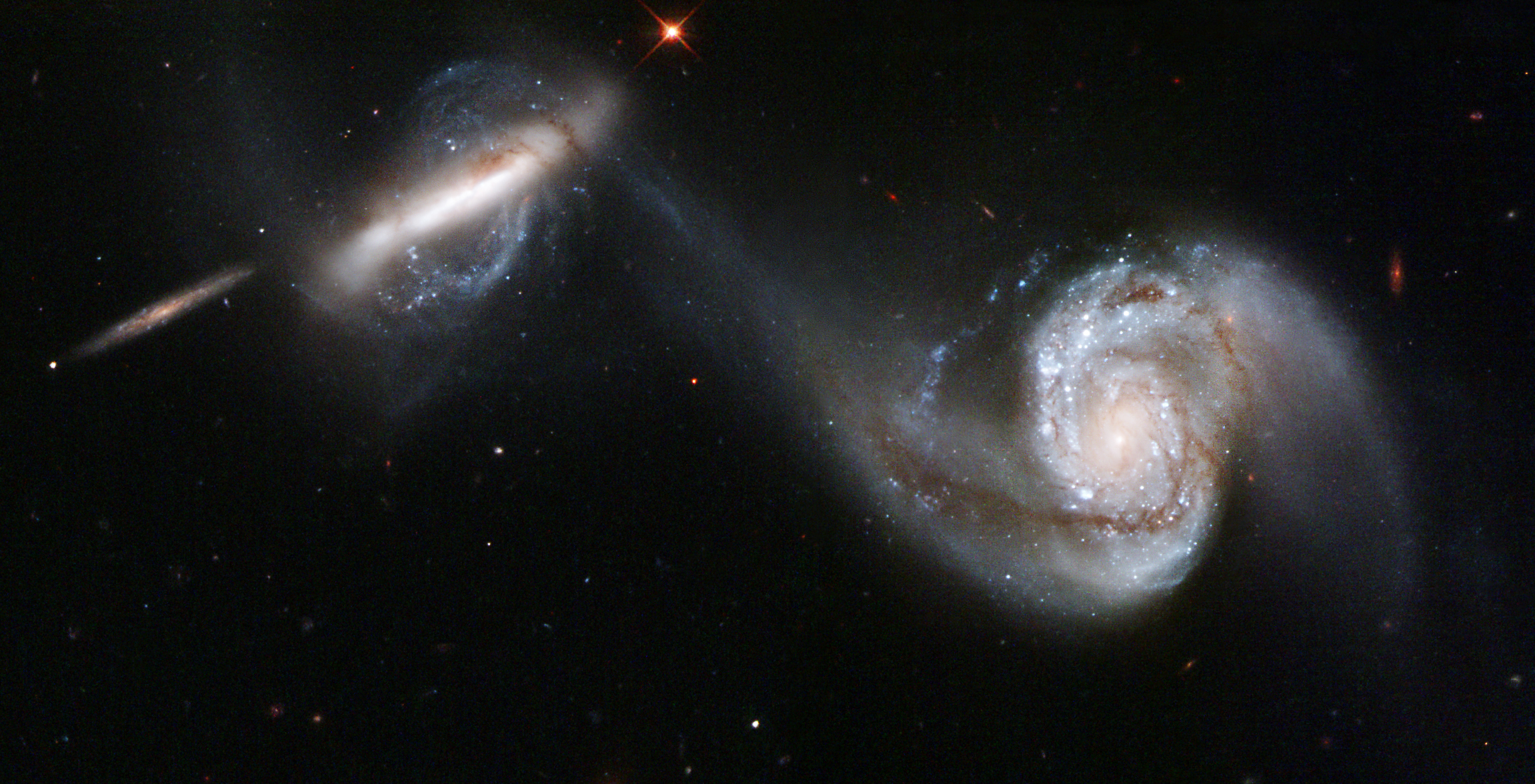 These two galaxies are known collectively as Arp 87. The bridge between them is made of stars, gas, and dust. It spans 75,000 lightyears, and shows that there is a gravitational connection between the two galaxies. At one point, the two galaxies came close to eachother and a "violent gravitational battle" ensued. This type of connection is relatively common, and it is expected that the two galaxies will eventually join to create one larger galaxy. The blue spots on the galaxy on the right are regions where new stars have recently formed. This was likely a result of the interaction between the two galaxies.
Friday, November 2, 2007
2.2 APOD
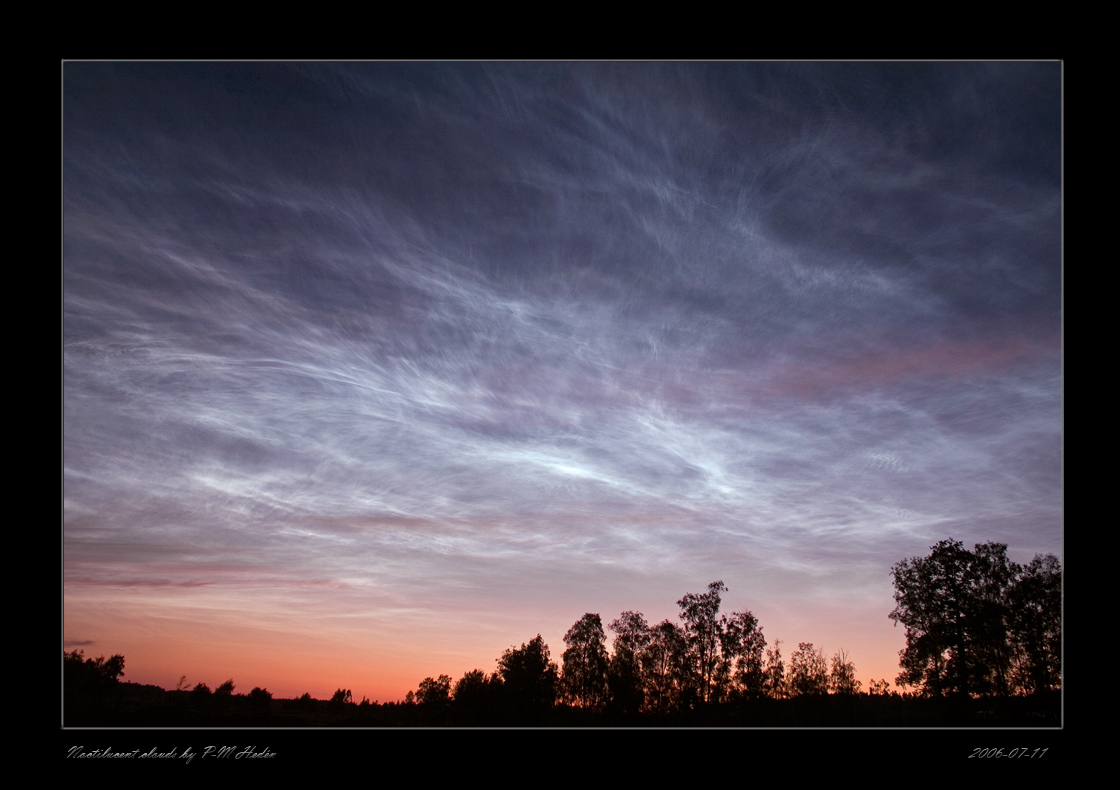 This picture was taken during a sunset in Sweden. Because sunset rises up, it often appears to be night on the ground and day in the air. This picture is a little different, however, because of the Noctilucent clouds seen in the sky. These Noctilucent clouds, also known as polar mesopheric clouds, are the highest clouds in the Earth's atmosphere. They are often visible in the summer months at places of high latitudes, like Sweden. Not much is known about these clouds, ut it is thought that they are made up of ice particles. Several satellites have been launched to study the objects. Scientists have found clouds similar to the Noctilucent clouds made of carbon dioxide on Mars.
Subscribe to:
Posts (Atom)