Friday, January 18, 2008

3.2 APOD


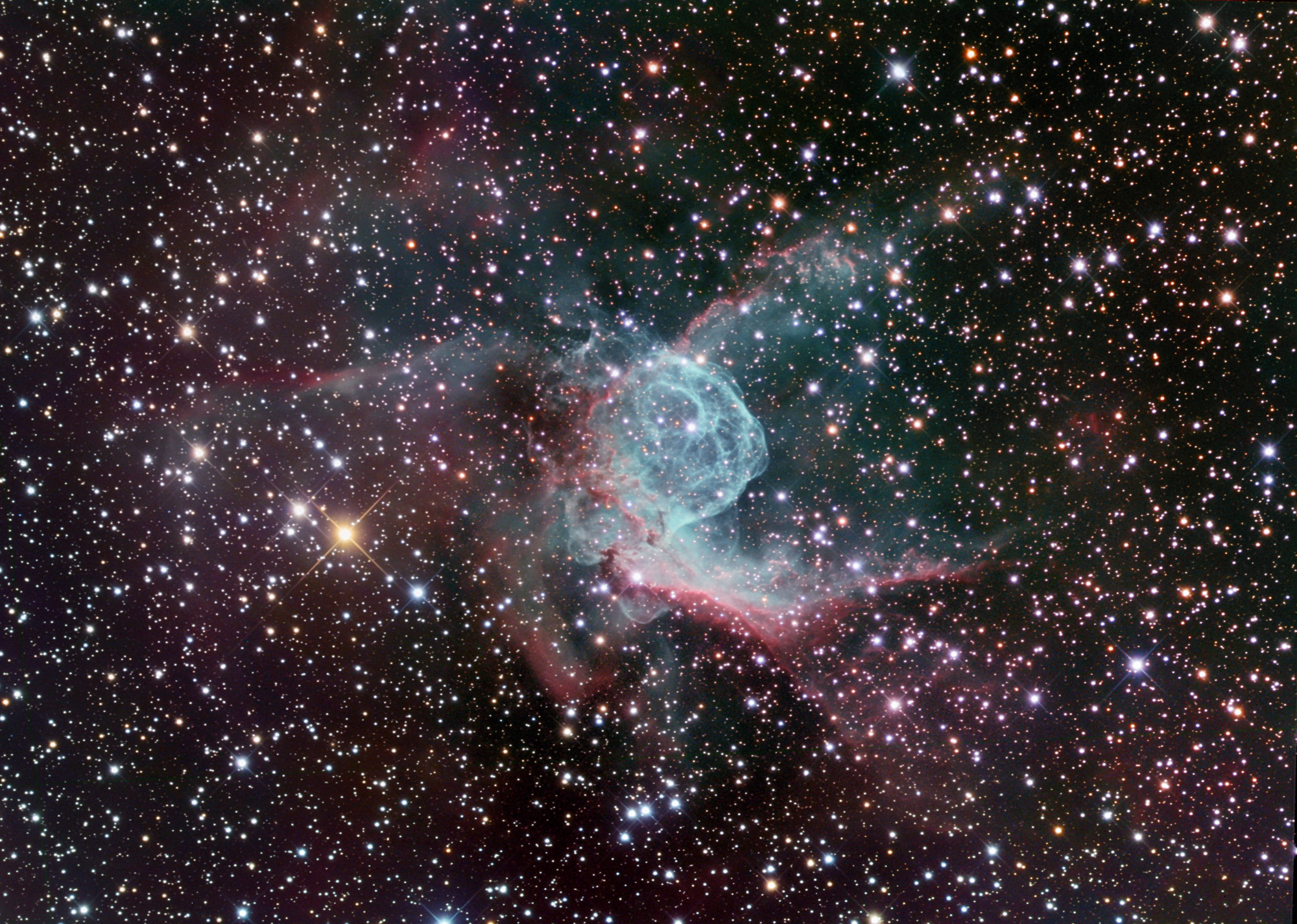
This nebula, NGC 2359, is more commonly known as Thor's Helmet. Thor is the Norse god of thunder. His helmet spans over 30 light-years. The star in the center of the cloud is supposed to be a very hot giant in the pre-supernova stage of evolution. The star is classified as a Wolf-Rayet Star which means that it has an atmosphere that compares to the thickness of the star itself. Most stars, however, have much thinner atmosphere. WR Stars also lose mass through wind at an extremely fast rate as it compares to the rate at which stars like our Sun lose mass. The emerald color in Thor's Helmet is is due to the immission of oxygen. The nebula is located about 15,000 light-years away from the Canis Major constellation.

Friday, January 11, 2008

3.1


This emission nebula, IC 1396, is made up of dark dust clouds and cosmic dust. The nebula is located about 3,000 light-years from Earth, and it stretches across several hundred light-years in size. This nebula is home to a star-forming region, called the Elephant Trunk Nebula, or IC 1396A. It is home to several stars that are less than 100,000 years old. It is a well-known nebula because it emits ligth in a visible wavelength. It alone is nearly 20 light-years long. The nebula, which is located in the constellation Cepheus, gets it's color from the hydrogen gas it emits.

Tuesday, January 8, 2008

Johann Madler


Johann Madler was born in Berlin in 1794. Madler’s interest in astronomy was sparked when he saw a comet as a child. Orphaned at a young age, Madler was responsible for raising his younger sisters. Madler studied astronomy and mathematics at the University of Berlin. During his time there he studied under both Encke and Ohm. To take care of his family and help pay for his education, Madler worked as a private tutor.

While working as a tutor, Madler meant a wealthy banker and amateur astronomer named Wilhelm Beer. Beer realized Madler’s abilities and offered him a position at the observatory that Beer was building. Madler, with Beer’s help, made a number of important contributions to astronomy.

Madler, while working at Beer’s observatory, made the most comprehensive map of the moon to date. He was the first to divide the moon into four separate quadrants. His maps of the moon were considered its most accurate documentation for the three decades after they were created.

Madler also made observations of Mars. He and Beer were the first astronomers to map the planet. Using Hershel’s calculations, they attempted to determine Mars’ rotational period, eventually coming within 1.1 seconds of finding the exact period. Though Madler was most famous for his observations of Mars and the moon, he made observations of Jupiter early in his career. His first contribution to astronomy was his discovery of two dark spots on Jupiter’s rings.

He also developed the Central Sun Hypothesis which said that the center of the universe, or more accurately the center of the universe’s gravity, is located in the star cluster known as the Pleiades. To find this, Madler observed the motions of over 3,000 stars. Though this hypothesis was eventually proven false, his observations were used by later astronomers.

After working with Beer, Madler accepted a position as director of the Dorpat Observatory in Estonia. Here he continued his observations of the moon and Mars. He also continued the research of the observatory’s former director, Friedrich Struve, who studied binary stars.

Madler also made important meteorological observations. He made the most accurate calculations of Earth’s tropical year.

Madler published his complete works, History of Descriptive Astronomy, in 1873. This was after he retired from his position in Estonia as a result of eye problems that prohibited him from doing observations. He retired to Germany, where he died in 1874.

Works Cited

Hockey, Thomas A. Galileo's Planet. CRC P, 1999. 8 Jan. 2008 .

"Monthly Notices of the Royal Astronomical Society." NASA Astrophysics Data System. Harvard University. 8 Jan. 2008 .

"Science Center AHHAA." Teaduskeskus. Dorpat Observatory. 8 Jan. 2008 .
Monday, January 7, 2008

Observation 2.2

Date: January 2, 2008
Time: 11:00-1:00
Place: Fruitville Road (East of the Interstate)
Sky conditions: Somewhat cloudy

Planets: Mars (orange in color and bright)

Bright Stars: Sirius, Orion's Belt, Beetlejuice (Beetlejuice looks like Mars, except it is not as bright and it twinkles)

Constellations: Gemini, Lepus, Orion

Other: The Quadrantids meteor shower was going on; most of the meteors we saw were small and vanished quickly; there was one meteor with a huge tail, it varied in brightness and the tail stretched about 100 degrees in the sky, it was bright white

Friday, December 21, 2007

2.8 APOD

This apod had a really clever name; it's called "Reflections on the 1970s". At first, I thought it was a reference to the decade, but then I found out that this is a picture of the NGC objects 1977, 1973 and 1975. They are usually ignored by astronomers who focus on the bright star-forming region in the Orion Nebula nearby. NGC 1977 is the most prominent of the nebulas in this photo. It is just above the center. All three are reflecting light because of the interstellar dust surrounding them. The picture was taken in New South Whales, Australia.

Friday, December 14, 2007

2.7 APOD

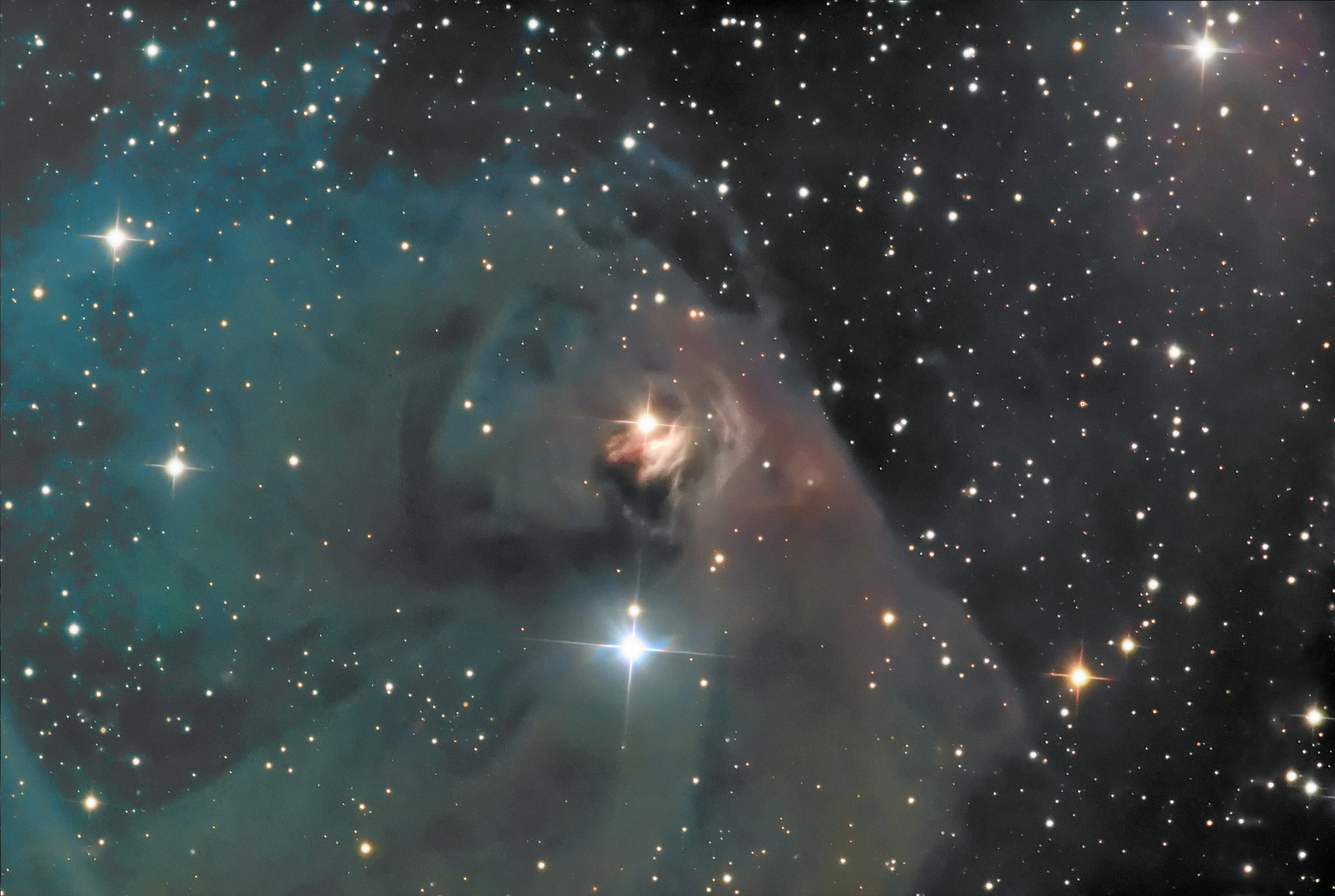
The bright star in the center of the photo is T Tauri. T Tauri is the prototype for the type of stars named after it. These are stars that have recently been revealed from the gasous clouds in which they were formed. They are usually a few million years old, and still in the early stages of development. The large cloud next to T Tauri is known as Hind's Variable Nebula. Hind's Nebula is interesting because it can vary drastically in brightness. The scope of the photo is about 4 lightyears across.

Friday, December 7, 2007

2.6 APOD

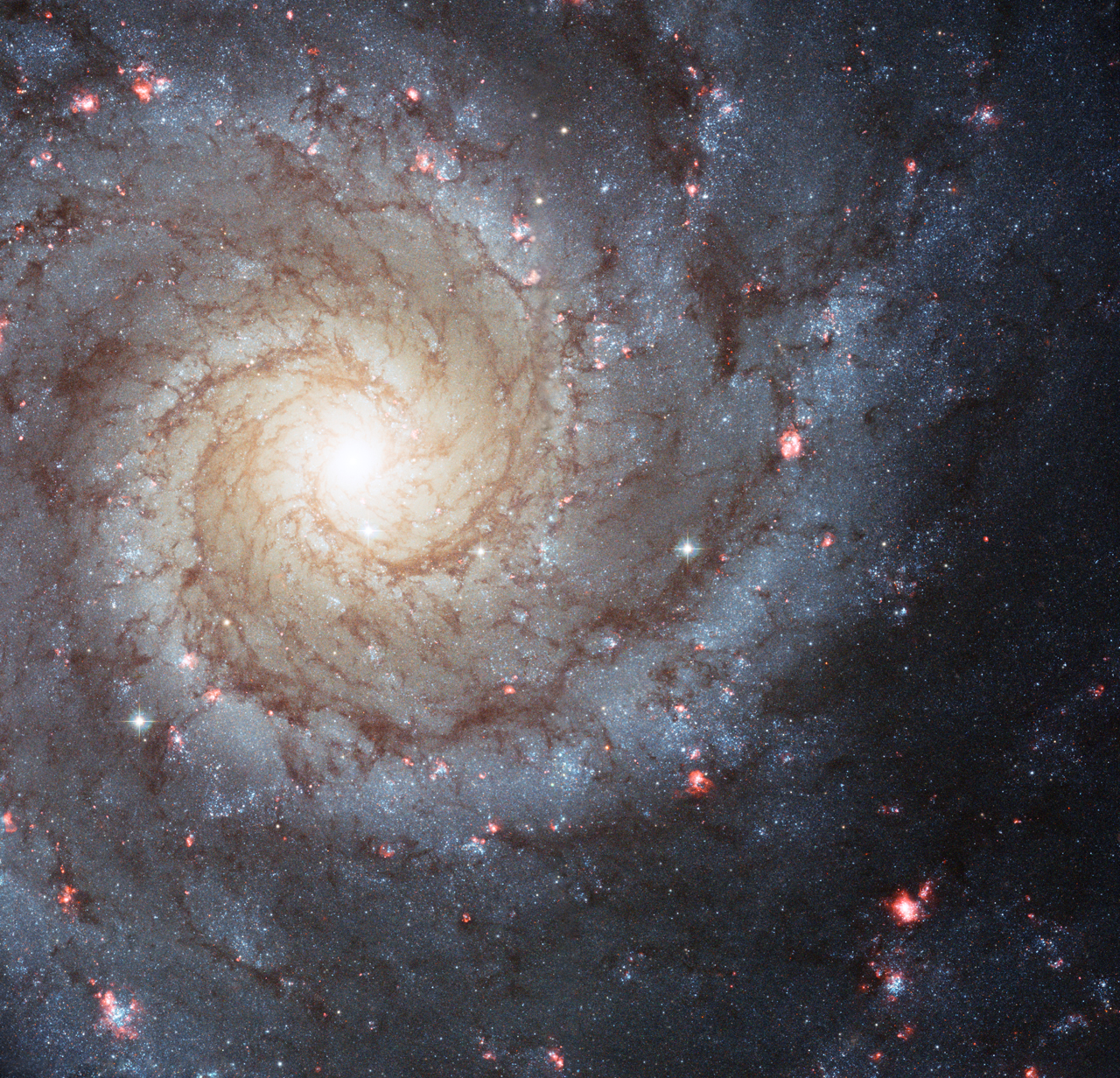
This is a spiral galaxy known as M47. It is composed of about 100 billion stars and is located 32 million light-years away from Earth, near the constellation Pisces. The arms of the spiral are made up of dust and gas, as well as blue star clusters. The red sections in the galaxy are star forming regions. The color comes from hydrogen gas. M47 is about 30,000 light-years across, and this photo was constructed from shots taken by the Hubble Space Telescope between 2003 and 2005.