Friday, April 18, 2008

4.3 APOD


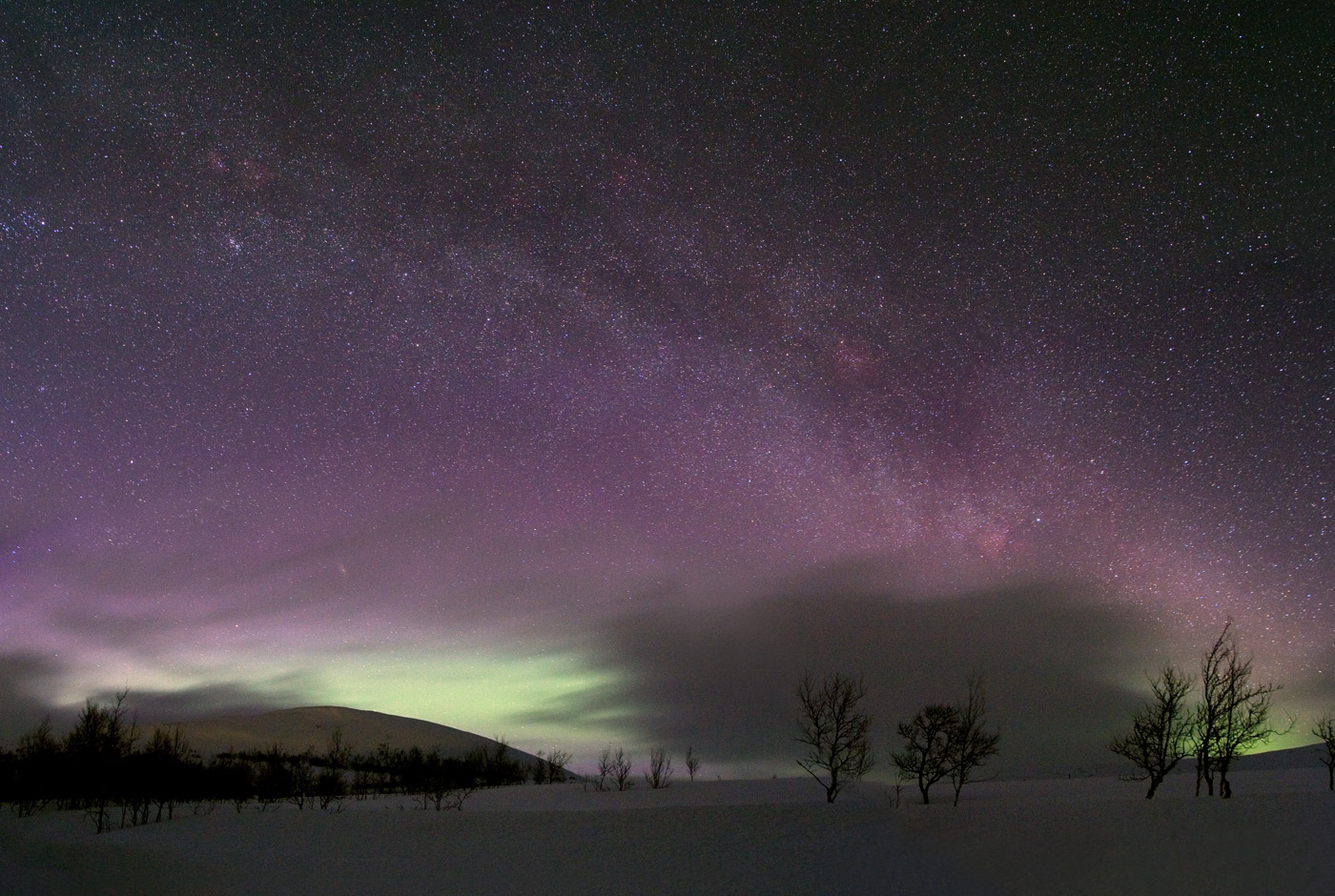
This is a really pretty picture of the night sky taken over Sweden. What makes this picture really cool are the amount of amazing things that can be seen in it. Not only are the snow-capped mountains and the trees very picturesque, but there are quite a few astronomical beauties captured in the photo as well. Red and green auroras can be seen in the distant sky. The red comes from a number of different emission nebulas including the Heart and Soul Nebula which is located in the constellation Cassiopeia, about 6,000 light-years away from Earth. Also in the picture, the Andromeda galaxy and the central plane of the Milky Way are visible. In addition to the Heart and Soul Nebula, the red gas comes from IC1396 and the North America Nebula. It is very rare to see all of these celestial bodies in one night, let alone to capture them in one photograph.

Friday, April 11, 2008

4.2 APOD


This is a really cool picture of a Large Magellanic Cloud, the largest satellite galaxy of our own galaxy, the Milky Way. The cloud, which lies about 180,000 light-years away from Earth, spans about 15 light-years across. In long exposure photographs like this one, LMC's resemble spiral galaxies. This specific cloud was home to the largest supernova in modern history. It got it's name because it is visible to the naked eye in the Southern Hemisphere and the explorer, Magellan, used the cloud to help him navigate. The Small Magellanic Cloud is located next to the Large Magellanic Cloud. The SMC is home to hundreds of millions of stars.

Friday, March 28, 2008

4.1 apod


On the left is a galaxy called M81. It is surrounded by blue spiral arms as it rests across from the red gas and dust clouds of M82. The galaxies are in a gravitational combat, and they have been for billions of years. In the next few billion years, only one of the two galaxies will have survived. Scientists suspect that the gravity waves sent off by M82 caused the richness of the blue spiral arms on M81. Both galaxies are huge. M81 is located in Ursa Major, and is one of the brightest galaxies as seen from Earth. M82 is an irregular galaxy, sometimes known as the cigar galaxy.

Monday, March 10, 2008

Observation 3.2

Date: March 8, 2008
Time: 9:30-10:15
Place: Bee Ridge Road (East of the Interstate)
Sky conditions: Pretty clear, there were a few clouds

Bright Stars: Betelgeuse, Rigel, Orion's Belt, Sirius, Castor, Pollux, Capella

Constellations: Orion, Ursa Major, Gemini, Auriga

Other: The moon was too new to be seen; the Big Dipper was visible in Ursa Major (it was standing on its handle)

Friday, March 7, 2008

3.8 APOD


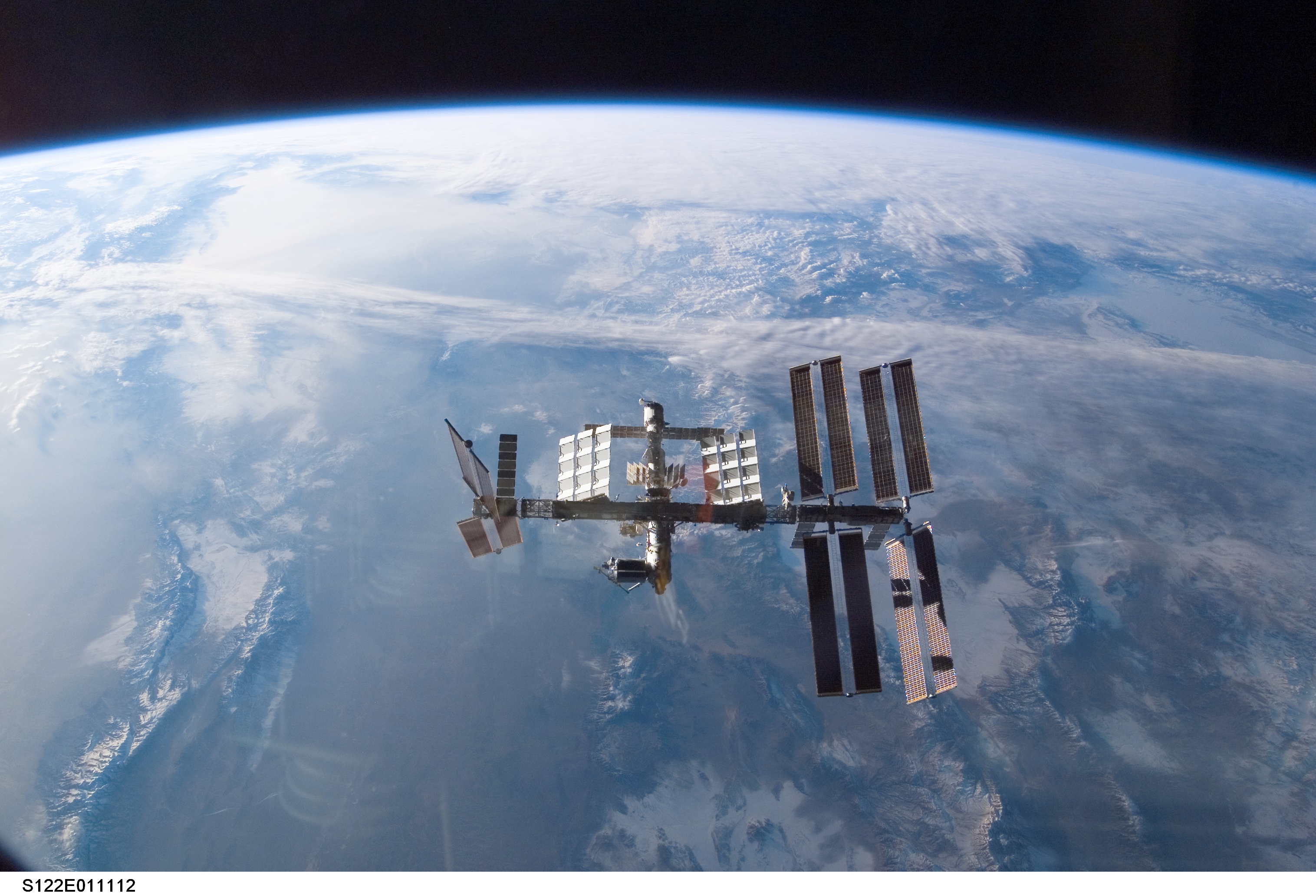
In this shot we see the International Space Station. Last month, the the space shuttle Atlantis added another piece to the ISS, the Columbus Science Library. This picture was taken by the crew of Atlantis as it returned to Earth. The ISS, which began contruction in 1998, has grown a lot in recent years. The ISS now has a supply ship, a robotic arm, and solar panels, all recent additions. According to the ISS, it is "the largest and most complex international scientific project in history." The orbit of the ISS is at a perfect angle to allow ships from the member countries to reach it with new technology, supplies, and crew members. It's angle also allows it to make good observations of Earth. Over 85% of the planet, housing over 95% of the world's population, can be observed from the ISS.

Wednesday, March 5, 2008

Asaph Hall Biography


Asaph Hall was born in Connecticut in 1829. He originally planned to work as a carpenter, but later decided to enroll in classes at Central College in New York. In 1856, Hall began a career at Harvard where it was discovered that he had a special talent for calculating the orbits of celestial objects.

After working at Harvard for six years, Hall took a job at the US Naval Observatory. Here, he quickly gained responsibility, and in 1875, he was made in charge of the largest refractor telescope in the world, USNO 66 cm/ 26in. In 1896, Hall returned to Harvard where he became a professor of astronomy, but not before making several important discoveries.

While working in Washington DC, Hall discovered a spot on the surface of Saturn that helped him determine the orbital speed of the planet. He later calculated the orbital patterns of Saturn’s moons. Hall’s most famous accomplishment was his discovery of the two moons of Mars, Phobos and Deimos. Hall named the two moons after the sons of Ares, the God of War. The names mean fear and panic.

Hall published a number of works including Determination of Aberration Constant, which he wrote while working as the Director of the Detroit Observatory at the University of Michigan. In this work, he discussed the parallax. Hall used parallax on his measurements for the size and distance of the Pleiades.

In 1879, Hall received the Gold Medal of the Royal Astronomical Society, the award’s highest honor. There are also craters on the Moon and Phobos named after Hall. Hall, who died at age 78, also did work in the area of mathematics. He inspired Captain O.C. Fox’s experiments involving random sampling. Hall’s contributions to astronomy have had an undeniable impact on the science.